
 AT
AT
Today marks a huge milestone for Don Whitley Scientific (DWS) as we celebrate our biggest anniversary yet: 50 years of DWS.
For many of our customers, suppliers and scientific partners, DWS has always been synonymous with our founder, Don Whitley. Whether you knew him personally, worked alongside him, or met with him at our headquarters, you'll likely remember the passion, determination and genuine interest he had in both people and microbiology.
What began in a spare room in Shipley in 1976 has grown into a scientific company with global reach, serving laboratories across more than 50 countries worldwide. Yet despite how much the business has evolved, the values Don built it upon remain unchanged. We remain a family-run business built on specialist microbiology and engineering expertise – small enough to care, big enough to deliver.
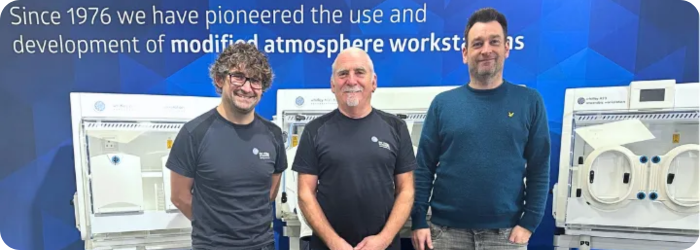
To mark this milestone, we sat down with our three owners – Paul Walton, Managing Director, Joe Walton, Sales Director, and Tom Walton, Service Director – for a fireside chat reflecting on the company's journey so far. Together, they shared memories of Don, discussed some of the defining moments from the last five decades, explored what continues to drive innovation at DWS, and looked ahead to what comes next.
You can read highlights from the conversation below or watch the full fireside chat recording here.
What do you think our founder Don Whitley would be most proud of if he saw the company today?
Paul: I think he'd be proud of the number of people working here today, particularly the young people who have a bright future ahead of them. He'd be proud of the fact that we're not living hand to mouth like we were when we started. He'd be proud of the product range we have now, how advanced it is, and the fact that we're selling products all over the world.
Someone made a comment earlier that there can't be many microbiologists in the world who haven't heard of Don Whitley. I think he'd be very proud of that.
Joe: And I think, to add to that, he'd also be very proud of how we've continued to have links with the scientific community, such as the UK Anaerobe Reference Unit who we help organise the P&CMAn course for, and how we’ve had the opportunity to take educational experience overseas with the help of Linda Veloo and team in Holland. He'd be proud of the further links we have with other groups who regularly visit this building and carry out seminars here.
Looking back over the last 50 years, do any moments stand out as a real turning point for the business?
Paul: If we go right back to the beginning to the very early days, Don, my Dad, had a great relationship with the purchaser for what was, then, the Public Health Laboratory Service.
Don had designed a new anaerobic jar with some innovative additions that he had patents on. We went down to Colindale in London to see this gentleman and following the visit, it was decided that those anaerobic jars would become the standard issue for the public health laboratories. He gave us an order for 50. These days that doesn't sound like a big deal, but at the time it was absolutely massive for us.
The next really big step came when Don decided to attend a meeting called Rapid Methods in Microbiology. I think this was around 1976 or 1977. He couldn't really afford to go, but Pam, his wife, and I encouraged him to do it anyway. He stayed in a run-down, little B&B rather than with all the delegates, but it was at that meeting that he met Ed Campbell and Sam Schalkowsky from America.
That led to him securing the agency for the Spiral Plater, which transformed us from selling tiny little things like anaerobic jars and media into selling our first piece of capital equipment. That gave us the finance necessary for him to develop what he really wanted to do, which was the anaerobic cabinet.
One thing helped another, and that put us in a position to make our own anaerobic workstation. We're still making them today, and that led on to pretty much everything that we've done since.
Joe: In more modern times, around 2008 when we launched what is now our current range of workstations - the A, H and M - I think that was a real turning point in how competitive we became. We still have a number of patents that are unique to us, and we're continuing to see the benefits from those today.
Tom: I also think buying Victoria Works in 2019 was a massive turning point for the business. I'd been with the company around 19 years by then and we'd been based in Shipley throughout that time. We moved through different premises, but it never really worked out as we'd hoped.
When the opportunity to buy Victoria Works came up, it gave us a massive platform to grow as a business. It's allowed engineering and R&D to expand, and it's enabled us to bring in more people.
It also coincided with COVID arriving and having that extra space was critical. I'd dread to think what would have happened if we'd still been in Shipley because it would have been a massive struggle. We had the space needed to continue operating and also to start distributing swabs, which was a big area of growth for us.
Victoria Works has also become one of our best marketing tools. We've held great meetings here with European partners, ALS, distributor meetings and customer events. For me, that was one of the real pivotal moments in the company's history.
How do family values continue to influence the way the company operates today?
Joe: What always strikes people when we talk about Don Whitley Scientific as a family company is that it isn't just the family you see sat here today.
It really is a family company throughout the business. We've got multiple husbands and wives, sons and daughters, and several generations of families who have worked here. You really get a strong family feel, and there isn't a person in this building who doesn't have a connection to somebody else.
I think you can extend that further to how we recruit people into the business. Quite often it is through word of mouth and recommendations, and that's served us really well over the years.
What keeps the company innovative after 50 years?
Tom: New technology is always a big part of it. A lot of the profits from the business are invested back into R&D because we want to stay ahead of the curve.
We've got a strong engineering department, a CMM machine, flatbed routers, 3D printers and a great R&D team. All of those things, certainly from an engineering point of view, help keep us ahead of the game.
We're always reinvesting and looking at ways to improve techniques, streamline processes and use better technologies, but having the right agencies is important as well. It's not just about who's selling our products; it's also about who we're selling for and who we choose to associate ourselves with. Working with good businesses that make quality products is important, both for the reputation of the company and for helping us improve ourselves.
We visited a potential agency the other week and you always learn something from seeing how other people do things. You see how their production works, how their engineering works and how they approach R&D. If you surround yourself with good people and like-minded businesses, I think that plays a big part in where we're heading.
Joe: We're fortunate to have two or three really strong product names that we now represent in the UK.
And to add to that, a lot of it comes through our connections with customers. Our sales team, R&D engineers and service engineers are constantly encouraged to speak with customers and engage with them because that's where many of our ideas come from in terms of future direction for our products.
Paul: I would also say that we have a really powerful intellectual base within the business. We have people who understand the processes, both from an engineering and microbiology perspective. We understand the scientific world and the engineering world, and that stands us in good stead when we're talking to customers.
Talking to customers is the most important thing, but we're also able to translate what they're asking for into real products because we've got the right people here to do that.
What’s next for DWS?
Joe: I think what we've found over the last few years is that the world is a turbulent place, so being diverse is really important. We've achieved that in a number of ways.
We've built a strong service operation, we've grown our consumables business through products such as Copan swabs, and we have our own capital equipment in the form of our modified atmosphere workstations, which we sell around the world.
Alongside that, we want to continue bringing in strong agencies that we can represent here in the UK and that complement the products we manufacture ourselves.
Tom: I think it's more of the same in many ways, but I'd also point to standards within the business and our culture. That's something you can never take your eye off. Every department needs to reach a standard that we're happy with, and that people are happy with. We need to keep working on how people feel about working here.
There has to be honesty in those discussions as well. Sometimes standards can slip, and the standard you walk past is the standard you accept. It's important that people understand that everybody has a voice and that everybody can make a difference.
It's not just down to the higher levels of the business. That's what we want to encourage and keep pushing forward. I think we've got strong foundations, and those foundations will take us a long way.
Looking Ahead
Fifty years on from those early days in Shipley, DWS continues to build on the foundations Don established: innovation, scientific collaboration, strong customer relationships and a commitment to doing things the right way.
While much has changed since 1976, the focus remains the same – supporting microbiologists around the world with specialist instrumentation, investing in our people, and continuing to push boundaries in microbiology.
To everyone who has been part of our journey over the last five decades – our employees, customers, distributors, suppliers and scientific partners – thank you for your support. Here's to the next 50 years!
Missed the fireside chat? Watch the full recording here to hear the stories, memories and reflections in full.





 England